
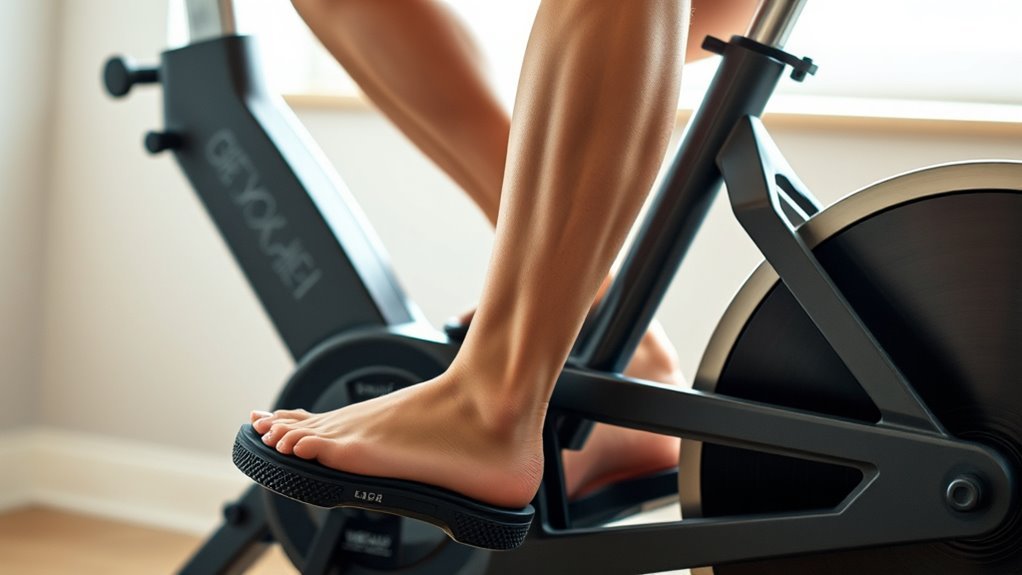
How Does a Stationary Bike Work Muscles?
When you pedal a stationary bike, you actively engage multiple lower body muscles like your quads, hamstrings, glutes, calves, and hip flexors. These muscles work together smoothly to create powerful motion that drives each pedal stroke. It’s a great way to build strength and endurance while getting your heart rate up.
Your core muscles also get involved, helping to stabilize your posture and keep your balance steady throughout your ride.
Different types of stationary bikes and varying resistance levels can change how these muscles work. Sometimes you might focus more on building strength, other times on improving stamina.
Keep experimenting with different bikes and settings, and you’ll find how each one targets your muscles in unique ways to match your fitness goals. It makes stationary biking a versatile and effective workout option.
Key Takeaways
- Stationary bikes primarily engage the quadriceps, hamstrings, glutes, calves, and hip flexors for efficient pedaling motions.
- Pedaling involves coordinated muscle work: quads power downstrokes, hamstrings and glutes extend hips, and hip flexors lift pedals upward.
- Core muscles stabilize posture and balance during cycling, reducing fatigue and enhancing endurance.
- Different bike types and resistance levels alter muscle activation intensity and focus on various lower body muscles.
- Air resistance bikes with movable handlebars also engage upper body muscles, including shoulders, arms, and back.
Which Muscles Are You Working on a Stationary Bike?

When you pedal a stationary bike, you primarily work your quadriceps, hamstrings, glutes, calves, and hip flexors. These lower body muscles form the core pedaling muscles responsible for powering each revolution.
The quadriceps extend your knee during the downward pedal stroke, while your hamstrings and glutes work together to extend the hip. This collaboration creates smooth, efficient motion.
Your calves, including the gastrocnemius and soleus, help with ankle flexion and force generation, which boosts pedal power. Meanwhile, your hip flexors lift the pedal back up, keeping your muscles engaged throughout the cycle.
Calves and hip flexors work together to enhance pedal power and maintain muscle engagement throughout cycling.
Beyond your legs, your core muscles—like your abdominals and lower back—activate to stabilize your posture and maintain balance. This muscle activation helps prevent fatigue and supports endurance during your ride.
How Different Stationary Bikes Change the Muscles You Use

Although all stationary bikes target your lower body muscles, the type of bike you choose can shift which muscles work hardest and how they engage.
On an upright bike, you’ll primarily activate muscle groups like your quadriceps, hamstrings, glutes, calves, and hip flexors through a smooth pedal stroke.
A recumbent bike changes the exercise bike design by positioning you reclined, altering joint angles and reducing lower back strain.
It still engages those same lower body muscles, but in a different way.
Spin bikes push muscle activation further with high resistance levels and intense pedaling.
They involve your quads, glutes, calves, and core to a greater extent.
If you use an air resistance bike with moveable handlebars, you’ll also recruit upper body muscles—shoulders, arms, and back—through push and pull motions.
So, depending on your chosen bike, resistance levels, and pedal stroke style, the muscle groups worked can vary considerably.
This lets you tailor your workout to specific fitness goals.
Frequently Asked Questions
Can I Lose Belly Fat by Riding a Stationary Bike?
Yes, you can lose belly fat by riding a stationary bike, especially with consistent workouts and a calorie-controlled diet.
High-intensity intervals boost fat loss, but overall fat reduction is key—you can’t spot-reduce belly fat alone.
Is 30 Minutes of Stationary Bike the Same as 30 Minutes of Walking?
No, 30 minutes on a stationary bike isn’t the same as 30 minutes walking. You’ll burn more calories, engage more muscles, and boost your cardio faster by cycling.
That’s mainly because of adjustable resistance and higher intensity. So, cycling can really ramp up your workout compared to walking.
What Are the Downsides of Stationary Bikes?
When you put all your eggs in one basket with stationary bikes, you risk muscle imbalances, strain injuries, and fatigue.
Plus, poor seat positioning can cause soreness. And you won’t build muscle like with weightlifting.
How Many Minutes a Day Should You Ride a Stationary Bike?
You should ride a stationary bike for 20-30 minutes daily to meet general fitness goals. Beginners can start with 10-15 minutes, then gradually increase time to 30-60 minutes for better endurance and weight loss benefits.
Starting out, it’s totally fine to keep it short and sweet. Just 10 to 15 minutes will get you going without feeling overwhelmed.
As you get more comfortable, try bumping up your ride time to anywhere between 30 and 60 minutes. This helps build endurance and can really boost your weight loss results.
Conclusion
When you hop on a stationary bike, you’re mainly working your quads, hamstrings, glutes, and calves. Different bike styles, like upright or recumbent, slightly shift the focus, but your legs stay the stars of the show.
Think of pedaling as a rhythmic dance where these muscles take turns pushing and pulling. So, while you might expect your upper body to join in, it’s really your lower muscles doing the heavy lifting every time you ride.
In short, a stationary bike works muscles mainly in your lower body. Your quads drive the pedaling motion, the hamstrings help pull the pedals back, and your glutes and calves add power and stability. Whether you choose an upright or recumbent bike, your legs are the main players. This makes stationary biking a great workout for building leg strength and endurance while also improving cardiovascular fitness. So next time you ride, remember your lower muscles are doing most of the work!