
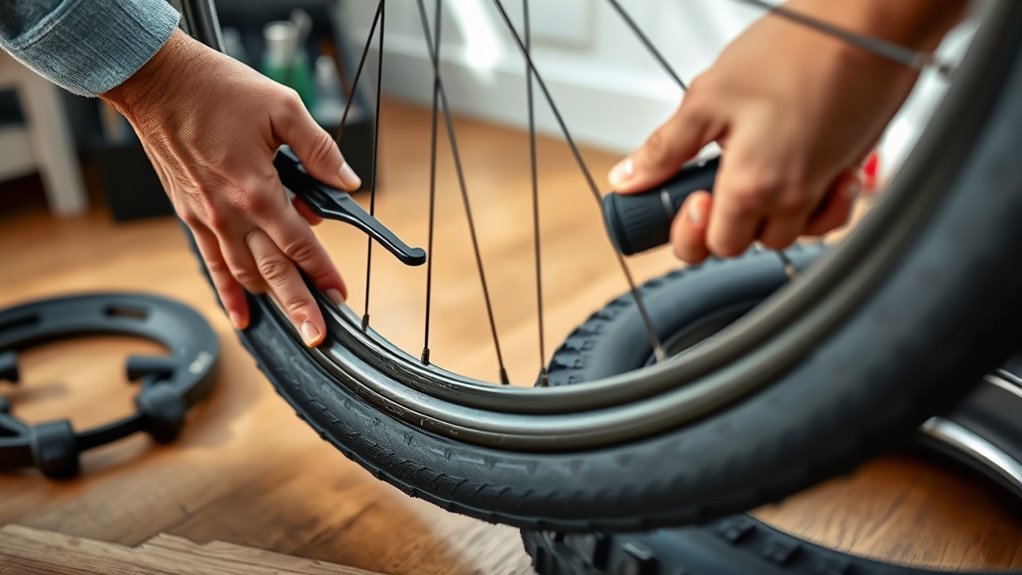
How to Change a Bike Tire in 3 Simple Steps
To change a bike tire in three simple steps, start by fully deflating the old tire. Use tire levers to carefully remove the tire and inner tube from the rim. This step is important to avoid damaging the rim or the new tube later on.
Next, slightly inflate your new tube just enough to hold its shape. While you’re at it, check both the tire and the rim for any debris or sharp objects that could cause another flat. Preparing everything properly makes the installation smoother and safer.
Finally, install the new tube inside the tire and seat the tire beads evenly around the rim. Inflate the tire to the recommended pressure, making sure it’s seated properly as you go. Keep going to discover useful tips for a smooth installation and to ensure your ride stays safe and comfortable.
Deflate and Remove the Old Tire
Before you can replace the tire, you’ll need to fully deflate it by pressing down on the valve to release all the air. Make sure no air remains trapped in the inner tube.
Next, use tire levers to pry the tire bead away from the rim, starting on the side opposite the valve to avoid damage. Insert a second lever and work it around the rim to loosen the entire bead.
Once loosened, carefully remove the tire and inner tube, pulling the valve through the rim hole. Check the inside of the tire and rim for any debris or sharp objects stuck near spokes or the rim edge.
This step ensures you won’t puncture the new tube once you inflate it later. Now, you’re ready to move on to preparing the new tube and tire.
Inspect and Prepare the New Tube and Tire
Once you have the old tire removed, take a moment to inspect and slightly inflate the new tube so it holds its shape and resists pinching during installation.
Carefully inspect the inside of the tire for embedded objects or damage that could cause another flat tire. Check that the rim strip is centered and intact to protect the inner tube from spoke ends.
Verify the valve is clean, straight, and properly threaded to prevent leaks. Also, confirm the tire’s directional arrow aligns with your wheel’s rotation for *ideal* performance.
| Step | What to Check |
|---|---|
| Inner tube | Slightly inflate, hold shape |
| Tire | Inspect for embedded objects |
| Rim strip | Properly centered, no damage |
| Valve | Clean, straight, threaded |
| Directional arrow | Matches tire rotation |
Reinstall and Inflate the Tire and Wheel
With the new tube slightly inflated and checked for damage, you can now insert the valve stem through the rim hole, making sure it stays straight. Partially inflate the tube to give it shape, then carefully work the tire bead over the rim edge, starting opposite the valve.
Move around the wheel by hand or use tire levers if needed, ensuring the bead seats evenly on both sides of the rim. Once the tire is properly aligned and the tube isn’t pinched, fully inflate to the recommended pressure printed on the tire sidewall.
Spin the wheel to verify smooth rotation and that the tire is securely seated. Finally, reinstall the wheel onto your bike, confident your tire is correctly inflated and seated.
Conclusion
Congrats, tire changer extraordinaire! You’ve bravely deflated, inspected, and reinstalled like a pro—who knew fixing a bike tire wasn’t rocket science?
Next time your tire betrays you mid-ride, you won’t panic or call for a rescue squad. Instead, you’ll channel your inner mechanic, wield those tire levers like a ninja, and inflate your way back to glory.
Remember, if you can conquer this, you’re basically ready to fix anything—except maybe a spaceship. Changing a bike tire might seem tricky at first, but with these simple steps, it becomes second nature.
So whenever you face a flat, just follow the steps: deflate, remove, inspect, reinstall, and inflate. Mastering how to change a bike tire not only saves you time but also keeps your rides smooth and trouble-free. Keep practicing, and soon this essential bike maintenance skill will feel like a breeze!