How Does a Recumbent Bike Work?
A recumbent bike works by letting you pedal in a reclined, supported position that’s easy on your back. This design is great for people who want a low-impact workout without putting too much strain on their joints.
You push the pedals positioned in front of you, which turn a flywheel connected to adjustable resistance.
This setup targets your quadriceps, glutes, and calves while keeping your core stable. The ergonomic seat and backrest make workouts comfortable, even for longer sessions.
Plus, the reclined posture helps reduce pressure on your spine, making it a popular choice for those with back issues.
Keep exploring to understand how this design boosts muscle engagement and exercise efficiency. It’s not just about comfort—it’s about getting a solid workout while protecting your body.
Mechanics and Design of a Recumbent Bike
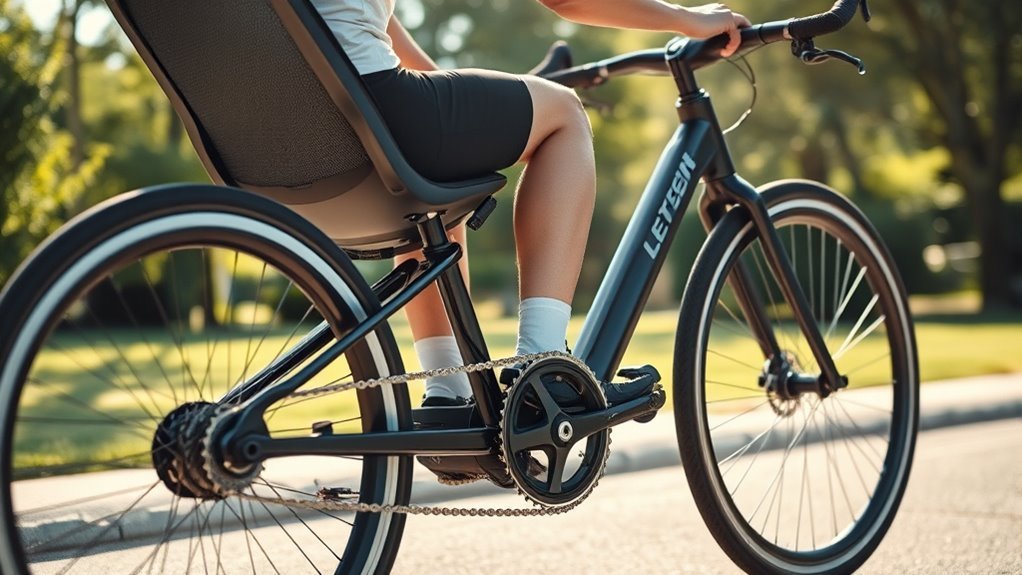
Although recumbent bikes look different from traditional bikes, they work on similar mechanical principles. When you use a recumbent bike, you’ll notice its unique design features reclined seating that provides ergonomic support with a comfortable backrest.
The pedal system sits in front of you, connected to a crank that powers the flywheel through a drive system—this may be a chain, belt, or direct drive. The flywheel interacts with a resistance mechanism, which adjusts the pedaling effort using magnetic, mechanical, or air-based methods.
The frame ensures stability while offering adjustable components, so you can personalize your ride for maximum comfort. Overall, the mechanics and design of a recumbent bike combine to deliver a smooth, efficient workout that supports your body ergonomically.
Muscle Groups Activated During Recumbent Bike Exercise
The ergonomic design and mechanics of a recumbent bike not only provide comfort but also target specific muscle groups during your workout. You engage your quadriceps as they contract to extend your knees in the downward pedal stroke, generating power.
Your glutes and hamstrings assist in hip extension, especially when resistance increases. Meanwhile, your calves and tibialis anterior stabilize your ankles and help propel your feet through each pedal stroke.
Core muscles and your lower back activate to maintain stability and proper posture.
| Muscle Group | Function | Role in Pedal Stroke |
|---|---|---|
| Quadriceps | Knee extension | Downward power push |
| Glutes & Hamstrings | Hip extension | Assist in force generation |
| Calves & Tibialis Anterior | Ankle stability | Propel foot through stroke |
Conclusion
Riding a recumbent bike is like steering a ship through calm waters—you’re in control, seated comfortably as your muscles gently power your journey. Just as a captain uses precise movements to glide smoothly, your legs and core work in harmony, propelling you forward with ease.
By understanding its design and the muscles engaged, you’re not just exercising—you’re mastering a vessel that carries you toward strength and endurance with every pedal stroke. The recumbent bike’s ergonomic seat supports your back, reducing strain and allowing longer, more enjoyable rides.
This unique setup targets different muscle groups compared to traditional bikes, offering a low-impact workout that’s easy on your joints. So, when you hop on a recumbent bike, you’re choosing comfort, control, and an effective way to boost your fitness. It’s not just a workout; it’s a journey toward better health and well-being.