Which Muscles Does Bike Riding Work?
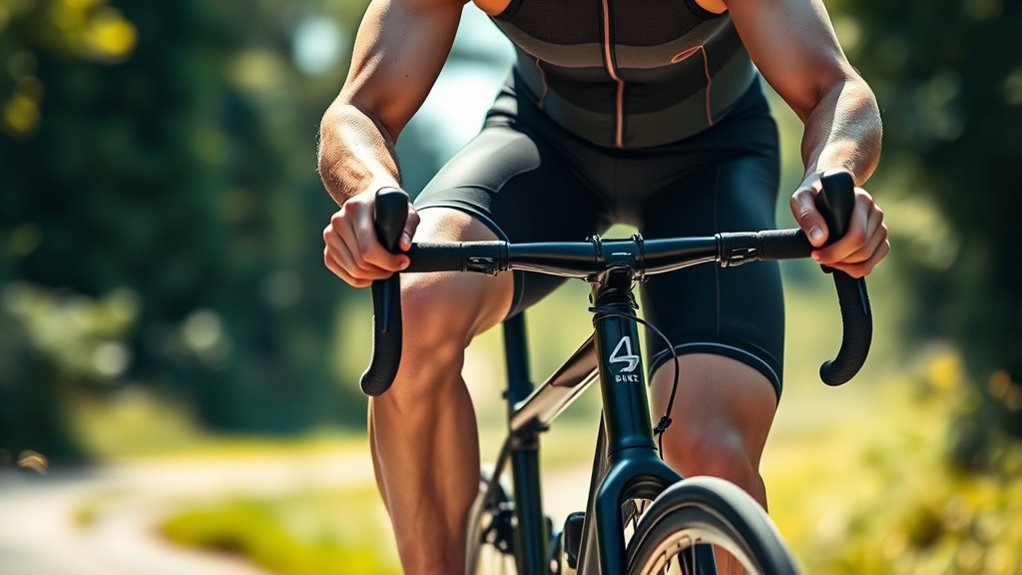
When you ride a bike, you primarily work your quadriceps to power the pedal downstroke, while your glutes kick in during climbs and sprints. These key muscles play a big role in making your cycling efficient and strong.
Your hamstrings also help by assisting with knee flexion and hip extension, working smoothly alongside your quads.
Meanwhile, your calf muscles stabilize your ankles and add extra push power.
Together, these muscles keep your pedaling smooth and effective. Want to get even better? Keep going to discover how targeted training can boost your cycling power and endurance even further.
Key Takeaways
- Bike riding primarily works the quadriceps, which extend the knee during the pedal downstroke. These muscles do a lot of the heavy lifting as you push down on the pedals.
- The gluteus maximus provides powerful hip extension, especially during climbs and sprints. It’s what helps you generate extra power when you need it most.
- Hamstrings assist in hip extension and knee flexion, coordinating with quadriceps for smooth pedaling. They work behind the scenes to keep your pedaling motion fluid.
- Calf muscles stabilize the ankle and contribute to pushing power during the pedal stroke. They might not get as much attention, but they play an important role.
- Core muscles support balance and efficient force transfer, enhancing overall cycling performance. A strong core helps you stay steady and pedal more effectively.
Key Cycling Muscles and Their Role in Pedaling
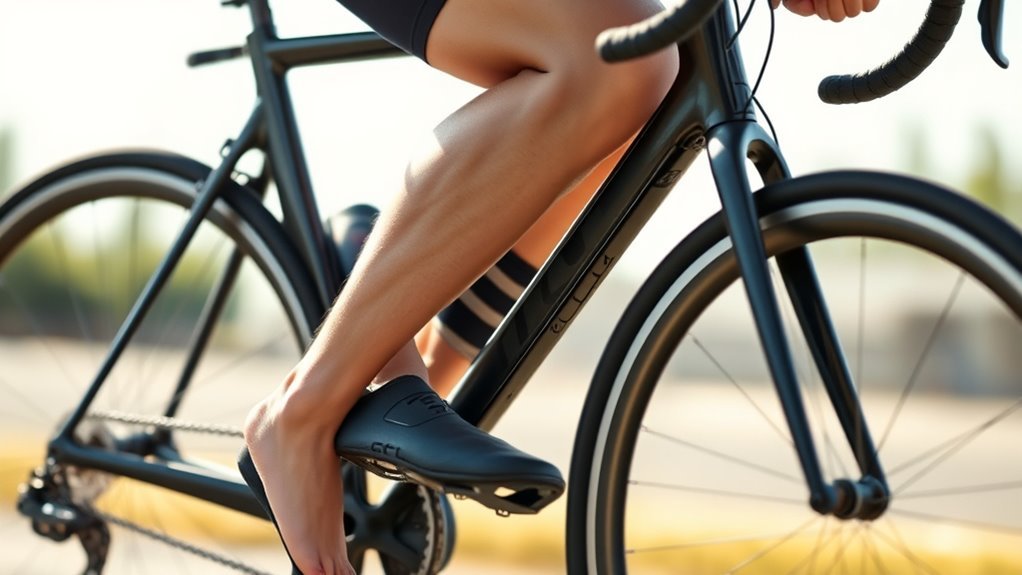
Although cycling might seem like a straightforward motion, it actually engages several key muscles that work together to power each pedal stroke. The quadriceps play a central role by extending your knee during the downward phase, driving the pedal with force.
Cycling involves key muscles like the quadriceps, which extend the knee to power each pedal stroke.
Meanwhile, your gluteus maximus contributes considerably to hip extension, especially when you’re pushing hard on climbs or sprinting. The hamstrings assist both in hip extension and knee flexion, coordinating smoothly with the quadriceps to maintain efficient pedal stroke mechanics.
Don’t forget your calf muscles, like the gastrocnemius and soleus—they stabilize your ankle and add power as you push down. This muscle activation from your lower body muscles ensures a continuous, fluid pedaling motion.
Together, these pedaling muscles work in harmony, allowing you to generate consistent power and maintain endurance on the bike. Understanding their roles helps you appreciate the complexity behind every pedal stroke you make.
How to Train Your Cycling Muscles for Power and Endurance
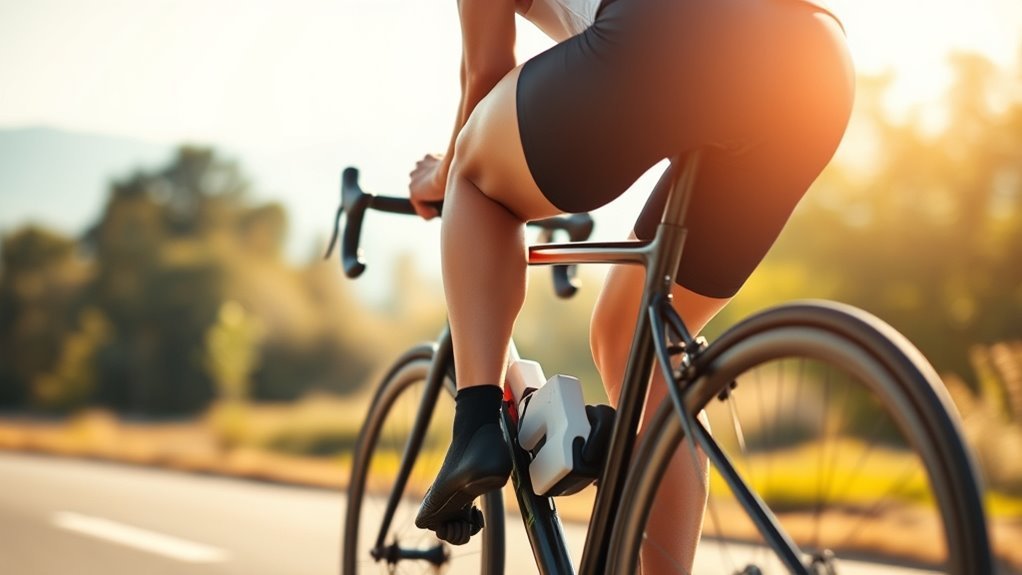
When you want to boost your cycling power and endurance, targeted training is essential. Focus on strength training with resistance exercises like squats, lunges, and deadlifts to reinforce key cycling muscles—quadriceps, hamstrings, and glutes. This really helps improve power development by activating those muscle groups better.
Try adding hill climbs and standing efforts on the bike. These moves specifically train your glutes and quads, which is great for building climbing strength.
To build endurance, mix in longer rides with some interval training. That way, you recruit more muscle fibers and really improve your stamina over time.
Don’t forget about core stability exercises like planks and Russian twists. A strong core supports your balance and makes force transfer more efficient when you’re cycling.
You can also add plyometric moves, like jump squats, to boost your explosive strength. This helps accelerate your power output when you need those quick bursts.
And it’s important to regularly work on muscle imbalances with varied exercises. This keeps your development balanced and helps prevent injury.
Frequently Asked Questions
What Muscles Get Toned From Cycling?
You tone your quadriceps, hamstrings, glutes, and calves when cycling. It also strengthens your core muscles like abs and lower back.
Plus, your shoulders, arms, and back get worked during longer or technical rides for better stability. So, cycling isn’t just great cardio—it’s a solid full-body workout too!
Is Biking 30 Minutes a Day Enough Exercise?
Yes, biking 30 minutes a day is enough exercise to improve your cardiovascular health and muscular endurance. You’ll boost fitness and mood.
But if you’re looking to build more muscle tone or go for hypertrophy, think about adding some strength training too. It’s a great way to complement your biking routine.
Does Cycling Tone Your Belly?
You know what they say, “No pain, no gain.” Cycling does tone your belly by engaging your core and burning calories.
But combining it with targeted exercises and a healthy diet will truly reveal those muscles.
Does Cycling Actually Build Muscle?
Cycling can build muscle endurance but won’t bulk you up much. You’ll strengthen your legs and glutes, which is great for overall fitness.
But if you’re after real muscle growth, you’ll need higher resistance or some extra strength training alongside your rides. Just pedaling alone won’t give you those big muscles.
Conclusion
Now that you know which muscles power your pedals, you can train smarter and ride stronger. Your quads, hamstrings, glutes, and calves work together like a well-oiled machine, turning effort into motion.
By focusing on building both power and endurance, you’ll keep your legs spinning smoothly, mile after mile. So, saddle up and let your muscles do the talking—because every ride is a chance to turn sweat into strength.
Bike riding is a fantastic way to work your lower body muscles while also boosting cardiovascular fitness. Whether you’re pedaling through hills or cruising on flat roads, your legs get a full workout that builds muscle and stamina. Remember, consistent cycling helps improve muscle tone in your quads, hamstrings, glutes, and calves, making each ride more efficient and enjoyable. So keep riding, and let your muscles grow stronger with every pedal stroke!