How to Measure Bicycle Wheel Size in 10 Easy Steps
To measure your bicycle wheel size accurately, start by stabilizing your bike and fully inflating the tires. This helps ensure the measurements reflect the actual size when the bike is ready to ride.
Next, check the tire sidewall for printed size markings like “26 x 1.75.” These numbers are your first clue about the wheel’s dimensions.
Now, measure the diameter by finding the distance from the ground to the wheel center and then doubling it. This gives you the full wheel diameter.
After that, measure the tire width across the tread and use a caliper to check the rim width.
Don’t forget to convert your measurements between inches and millimeters. That way, you can match your wheel size to standard sizing charts.
Keep following these steps to discover precise methods and useful tips for an accurate fit every time.
Prepare Your Bicycle for Measurement
Before you begin measuring, make sure your bicycle is stable by placing it on a kickstand or leaning it against a wall. Bicycle stability is essential to get accurate measurements of your wheel diameter and tire width.
Ensure your bike is stable on a kickstand or against a wall for precise wheel and tire measurements.
Use a sturdy, flexible tape measure—preferably metal—to avoid stretching or bending that could skew your readings. Also, verify the bike stands upright and the tires are fully inflated; underinflated tires can affect the tire width measurement.
When measuring, keep the tape measure steady from the ground up to the wheel’s center to find the radius, then double it for the wheel diameter. Stay focused on maintaining bicycle stability throughout the process to prevent errors caused by movement or tilting.
This preparation sets the stage for precise measurements. So, take your time and get everything just right before you start.
Locate and Read Tire Size Markings
When you want to find your bicycle’s wheel size, start by locating the tire size markings printed on the sidewall of the tire. These markings clearly show key details like the diameter and width of your tire.
You’ll often see measurements in inches, such as 26 x 1.75, where the first number indicates the tire’s diameter and the second its width. Alternatively, you might find ISO standards listed, like 55-559, where the first number is the tire width in millimeters and the second is the bead seat diameter.
Reading these markings accurately is vital to guarantee you pick the right replacement or upgrade. So, always double-check the tire size markings on the sidewall before proceeding with any changes.
Measure Wheel Diameter Using the Standard Method
To measure your wheel diameter accurately, start by placing your bike upright on a stable surface. Use a tape measure to find the distance from the ground to the center of the rim. Make sure the tape is straight and level.
Then, simply double this measurement to get the full diameter of your wheel. It’s a straightforward way to get an accurate size without any fancy tools. Give it a try!
Measuring Rim Diameter
Although measuring a bicycle wheel’s rim diameter might seem straightforward, getting an accurate measurement requires some care. To measure the rim diameter, position your tape measure or ruler across the widest distance of the rim, ensuring it passes through the center of the wheel.
Take multiple diameter measurements at different points around the rim to account for any irregularities, then calculate the average for accuracy. If you need to convert your measurement from inches to millimeters, multiply by 25.4 to standardize.
When working with a tire-mounted wheel, measure the circumference at the bead seat area using a flexible tape. Then divide that number by pi (3.142) to approximate the rim diameter. This method guarantees you get the precise rim diameter essential for sizing.
Using Tape Measure
Since accurate measurement starts with a stable setup, stand your bike upright and make certain it won’t tip over before you begin.
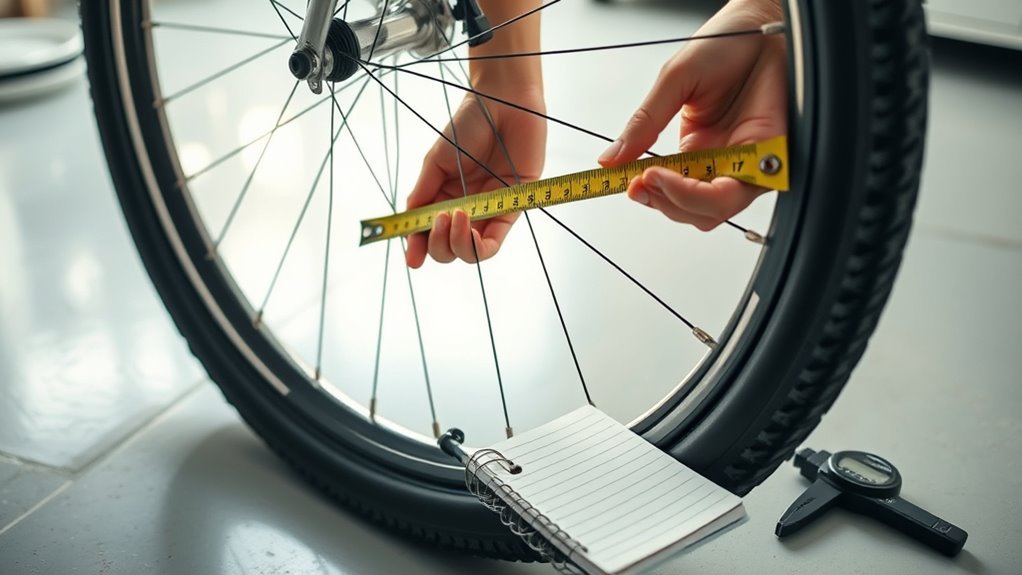
Grab a retractable metal tape measure to measure your wheel size precisely. You can measure the diameter in two ways: first, place the tape measure on the ground and measure up to the wheel’s center point, then double that length to get the diameter.
Alternatively, measure directly across the wheel from one rim to the other, passing through the center. Record your measurement in inches or millimeters, depending on your preference.
Finally, round your measurement to the nearest half-inch or millimeter to identify the standard wheel size. Using a tape measure this way ensures you get an accurate diameter for your bike’s wheel.
Measure Tire Width Across the Tread
To measure your tire width accurately, grab a ruler or tape measure and check across the tread at its widest point. Make sure the tire is fully inflated and properly seated on the rim before you measure.
This width helps you pick the right replacement tires and guarantees a perfect fit. It’s a simple step, but it makes a big difference when you’re shopping for new tires.
Measuring Tire Width
How do you accurately measure the width of your bicycle tire? Start by making sure the tire is fully inflated and properly seated on the rim. This step is super important for getting a precise measurement.
Next, grab a ruler or tape measure and place it across the widest part of the tire’s tread. Make sure you measure perpendicular to the wheel’s axis. Record the measurement in millimeters or inches—whichever you prefer or need for compatibility.
To get an even more accurate reading, take measurements at several points along the tread and then calculate the average. Lastly, don’t forget to check the tire’s sidewall markings. This way, you can confirm that your measurements match the manufacturer’s specified tire width.
Tools for Width Measurement
Accurately measuring your tire’s width means having the right tools on hand. You can use a ruler, tape, or caliper to measure the tire’s width across the tread from one sidewall to the other. Make sure your measuring tool stays straight and flat to get a precise reading.
Focus on the widest point of the tread, avoiding any bulges or irregularities. For the best results, take several measurements at different points and average them out.
Always measure when the tire is properly inflated and mounted on the rim, as this reflects its true width during riding. Record your measurement in millimeters or inches, depending on your preference or tire specifications. This way, you ensure accuracy every time.
Remove the Wheel to Access the Rim
Before you can measure the rim, you’ll need to remove the wheel from your bike. Start by securely lifting or stabilizing your bike so you can easily access the wheel.
First, lift or stabilize your bike to easily access and remove the wheel for rim measurement.
Next, take off the axle nuts or quick-release skewer that’s holding the wheel in place. If your bike has brake calipers, make sure they’re disengaged to free the wheel smoothly.
Carefully lift the wheel off the fork or rear triangle without damaging any parts. Once it’s off, place the wheel on a flat surface or hold it steady so you can measure the rim accurately.
Don’t forget to keep track of any spacers, washers, or other small components. You’ll want to reinstall the wheel correctly after you’ve measured the rim.
This step is super important before you measure the rim’s diameter and width precisely.
Measure Rim Diameter and Width Precisely
To measure rim diameter accurately, use a flexible tape or ruler to get the distance across the bead seats at several points and average the results.
Next, determine the rim width by measuring the internal distance between the bead seats.
Using precise tools guarantees your measurements match standard sizing and help you find the perfect fit.
This way, you’ll be sure the rim size is right before you buy or replace tires. It’s a simple step that saves a lot of hassle later!
Rim Diameter Measurement
When measuring your bicycle rim diameter, you’ll want to use a ruler, tape measure, or caliper to find the widest distance across the rim from one bead seat to the opposite bead seat. This bead seat diameter is vital when you measure the wheel size accurately.
Take several diameter readings at different points around the rim to spot any irregularities, then average these measurements for precision. Using a flexible tape or caliper ensures the tape stays snug and straight without slack.
If your rim has a tire mounted, wrap a thin wire or string around the bead seat, mark its length, then measure the wire to determine the rim diameter. Remember to convert inches to millimeters by multiplying by 25.4 if you need compatibility with ISO or ETRTO sizing standards.
Rim Width Determination
Although measuring the rim diameter is essential, determining the rim width precisely guarantees your tire fits perfectly and performs well. To measure the rim width, use a caliper to span the widest point across the outside of the rim.
Take your measurement in millimeters (mm) for accuracy, especially if you’re dealing with non-standard or older rims. Avoid relying on just a ruler, as curvature can distort results.
Double-check your measurement by comparing it to manufacturer specifications or markings on the rim. Accurate rim width measurement ensures you choose the right tire size, preventing fit issues and improving ride quality.
Using a caliper for both diameter and width measurements helps you get precise, reliable data every time. It’s a small step that makes a big difference in how your bike rides!
Tools for Accuracy
How do you guarantee your rim measurements are spot on? Using the right tools is key. A digital caliper helps you measure rim diameter and width precisely.
Place it across the inside of the rim to get the internal bead seat diameter. Take readings at multiple points and average them for accuracy.
When measuring rim width, align the caliper perpendicular to the spokes. Measure the inside width at the widest part.
For circumference, wrap a flexible measuring tape around the rim’s outer edge or use string to mark the length. Then measure with a ruler.
Always record these measurements in millimeters to match ISO or ETRTO standards.
With a caliper and measuring tape in hand, you ensure your wheel size data is exact every time. Easy, right?
Calculate Rim Circumference for Accuracy
Since precise measurements are key to fitting the right tire, you’ll want to wrap a flexible measuring tape or string snugly around the rim’s bead seat area. Make sure the tape measure sits flat and tight to get an accurate circumference.
If you’re using string, mark where it overlaps after one full wrap, then straighten it out to measure its length with a ruler or tape measure. For the best results, take several circumference measurements around the rim and average them.
Once you have the circumference, calculate the rim diameter by dividing that measurement by pi (3.142). This rim diameter helps you find the exact wheel size, ensuring a perfect tire fit every time without guesswork.
Convert Measurements Between Inches and Millimeters
Why does converting between inches and millimeters matter when measuring bicycle wheels? Since tires and rims often list sizes in both units, you need to understand how to switch between them for accurate measurements.
To convert inches to millimeters, multiply your measurement in inches by 25.4. For example, a 26-inch tire equals about 660.4 millimeters (26 x 25.4).
Conversely, divide millimeters by 25.4 to get inches. This ensures you’re working with consistent data whether your specs use metric or imperial units.
Always double-check your conversions with a calculator to avoid mistakes that could lead to buying the wrong tire size. Mastering these conversions helps you confidently measure and select the right bicycle wheel size every time.
Compare Measurements to Standard Wheel Sizes
When you measure your bicycle wheel’s diameter, you can compare it to standard sizes like 26 inches, 27.5 inches, 29 inches, 700C, or 20 inches to identify the correct fit. This standard method helps you match your tire sizes accurately by using either diameter in inches or ISO size in millimeters.
Here’s how to compare:
- Convert your wheel’s diameter to millimeters and check the ISO size—26-inch wheels usually have an ISO size of 559 mm, while 700C corresponds to 622 mm.
- Match your measurement against common sizes like 20-inch (406 mm) or 29-inch wheels for compatibility.
- Use size charts to guarantee your diameter aligns with standard tire sizes, helping you find the perfect replacement or upgrade without guesswork.
Verify Measurements Against Manufacturer Specifications
Although you might have accurate measurements of your bicycle wheel, always double-check them against the manufacturer’s specifications.
You can find these specs on the tire sidewall or in your bike manual. This helps make sure your wheel size matches the ETRTO code and confirms compatibility with tires or rims.
Use the table below to compare your measurements with manufacturer specifications:
| Measurement Type | Manufacturer Specifications |
|---|---|
| Diameter (mm) | 622 |
| Width (mm) | 35 |
| ETRTO Code | 622-35 |
If you spot any differences, don’t install tires that don’t fit. Manufacturer specifications are your best guide to ensure your wheel size measurements are accurate and safe for riding.
Conclusion
Now that you’ve measured your bicycle wheel with precision, imagine the smooth ride ahead—each rotation perfectly aligned with your effort. With your tire size clear, you’re ready to glide confidently, whether on city streets or winding trails.
Trust these steps to keep your wheels rolling true, making every journey feel effortless and enjoyable. Remember, a well-measured wheel is the heart of a great ride, turning your cycling dreams into reality.
Accurately measuring your bicycle wheel size ensures the best fit for your tires and rims, improving performance and safety. So take these simple steps seriously, and enjoy the confidence that comes with knowing your bike is ready to hit the road or trail perfectly.