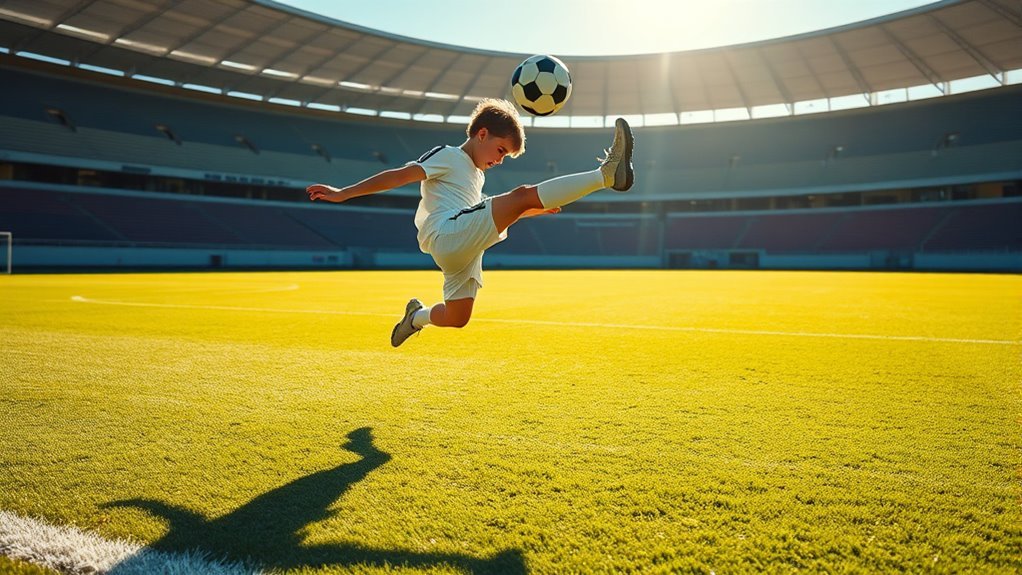
How to Do Bicycle Kicks in 5 Easy Steps
To do bicycle kicks in 5 easy steps, start by positioning yourself a few steps behind the ball with feet shoulder-width apart. This stance helps you get the right balance and momentum for the kick. It’s all about setting up correctly before you jump.
Next, jump higher by driving your non-kicking knee up explosively while engaging your core. This move gives you the lift and power needed to connect with the ball. Your core strength really makes a difference here.
Then, lean back and rotate your hips and shoulders to position your kicking leg for a powerful strike. This rotation is key to generating force and accuracy. You want to make sure your body is aligned just right.
Hit the ball cleanly with your laces, keeping your ankle locked. Striking the ball properly ensures a strong and controlled shot. Focus on making solid contact.
Finally, land safely by bending the opposite leg and using your arms for balance. This helps you avoid injury and maintain control after the kick. Keep practicing to master each move perfectly!
Key Takeaways
- Position yourself a few steps behind the ball, facing the goal with knees slightly bent and dominant foot back for balance.
- Jump explosively by driving your non-kicking knee upward while engaging your core for maximum height.
- Lean back and rotate your waist and shoulders early to position your kicking leg correctly.
- Strike the ball cleanly with your foot’s laces, keeping your ankle firm and swinging your leg smoothly.
- Land safely by bending the opposite leg, extending your arms for balance, and avoiding falls on your back or heels.
Set Your Starting Position for a Bicycle Kick

Before you attempt a bicycle kick, position yourself a few steps behind the ball, facing the goal with your body square or slightly angled. This starting position is *vital* because it sets the foundation for a successful kick.
Position yourself a few steps behind the ball, facing the goal, with your body square or slightly angled.
Stand with your feet shoulder-width apart to maintain balance. Place your dominant foot slightly back, ready to push off when you jump. Your body position should be stable but flexible, allowing you to move quickly.
Keep your eyes locked on the ball to anticipate its trajectory. Bend your knees just enough to prepare for the explosive jump ahead. This balanced stance ensures you can smoothly *shift* from the ground into the airborne kick.
Mastering this starting position and body position will help you execute the bicycle kick with control and power. Without a solid setup, you’ll struggle to generate the momentum and precision needed for this advanced soccer move.
Jump Higher by Driving Your Non-Kicking Knee Up

When you drive your non-kicking knee up forcefully, you generate the explosive power needed to jump higher for your bicycle kick. To maximize your jump height, bend your non-kicking leg at the knee and lift it as high as possible.
This upward drive propels your body off the ground, giving you the elevation required to execute the kick effectively. Timing is crucial—coordinate the knee lift with your push-off from the toes for maximum vertical lift.
Engage your core muscles to stabilize your body and enhance the upward motion created by driving the knee. Focus on quick, explosive movements rather than slow lifts to maximize jump height.
Lean Back and Rotate to Position Your Kicking Leg

As you jump, lean back and rotate your body to position your kicking leg for a clean strike. Leaning back helps create the natural body rotation needed to bring your leg into the right spot.
Tilt your shoulders and hips backward, which opens up space for your leg to move freely and improves your accuracy. Start rotating your waist and shoulders early in the jump, turning them toward the direction of your kick.
This rotation guarantees your back faces the goal, allowing you to surprise defenders while maximizing your reach at the ball’s highest point. Use your non-kicking arm to balance and control this rotation, keeping your body steady as you prepare to strike.
Strike the Ball Cleanly With Your Foot’s Laces
With your body properly leaned back and rotated, you’re ready to focus on striking the ball cleanly using your foot’s laces. Position your foot so the laces make direct contact with the ball’s center—this gives you the best control and a powerful strike.
Keep your ankle firm and locked to stop your foot from collapsing on impact, ensuring a precise hit. Instead of just hitting the ball, aim to strike through it, creating a clean, looping trajectory.
Practice swinging your leg smoothly and in control to build consistency.
| Key Aspect | Tip |
|---|---|
| Foot Position | Laces hit center of ball |
| Ankle | Keep firm and locked |
| Strike Technique | Strike through, not at the ball |
| Motion | Smooth, controlled swing |
Mastering these helps you strike with power and control every time.
Land Safely After Your Bicycle Kick
Although executing a bicycle kick feels thrilling, you must focus on landing safely to avoid injury. As you come down, bend the leg opposite your kicking foot to cushion the impact and protect your joints.
Extend your arms outward—especially the one opposite your kicking leg—to help balance and control your fall. Aim to land on the padded parts or the ball of your foot, not flat or on your heel, to absorb shock effectively.
Keep your body slightly forward and avoid falling directly on your back, as this reduces injury risk. Practicing controlled landings gradually builds confidence and muscle memory, making your landings smoother and safer over time.
Frequently Asked Questions
How to Bicycle Kick Step by Step?
You position yourself with your back to the goal, jump by driving one leg down, lift the other knee, lean back, strike the ball with your laces mid-air, then bend your landing leg and use your arms to absorb impact.
Sounds tricky, right? But once you get the hang of each step, it starts to feel more natural. Just take it slow and practice those movements one at a time!
How to Do Bicycle Kicks Correctly?
You might think bicycle kicks are too hard, but you can do them correctly by timing your jump, leaning back for rotation, striking with your laces, and landing safely.
Practice these steps to boost your skill and confidence. Give it a try, and you’ll get the hang of it faster than you think!
How to Do a Bicycle Kick in Real Life?
You jump backward with momentum, driving your knee up while leaning back. Strike the ball with your laces mid-air.
Then, rotate your body toward the goal. After that, land safely using your arms and bent leg to absorb the impact.
It might feel tricky at first, but with practice, you’ll get the hang of it!
Is a Bicycle Kick Easy?
A bicycle kick isn’t a walk in the park; it’s like catching lightning mid-air.
But if you trust your body and practice steadily, you’ll flip fear into fluid motion and make it feel easier every time.
Conclusion
Now that you know how to do bicycle kicks in five easy steps, it’s time to practice and perfect your technique. Remember, “practice makes perfect”—the more you try, the better you’ll get.
Focus on your form, timing, and safety every time you attempt the move. With determination and patience, you’ll soon be executing bicycle kicks confidently and impressively on the field.
Keep pushing yourself, and enjoy the thrill of mastering this exciting skill! Practicing bicycle kicks regularly will help improve your coordination and agility. So don’t get discouraged if it takes a few tries to get it right.
Stay motivated and keep working on your technique, because mastering bicycle kicks can really elevate your soccer game and make you stand out during matches. You’ve got this!