How to Measure Bike Tire Size in 5 Simple Steps
Start by making certain your bike is stable and the tire fully inflated. This is important because an unstable bike or a flat tire can give you inaccurate measurements.
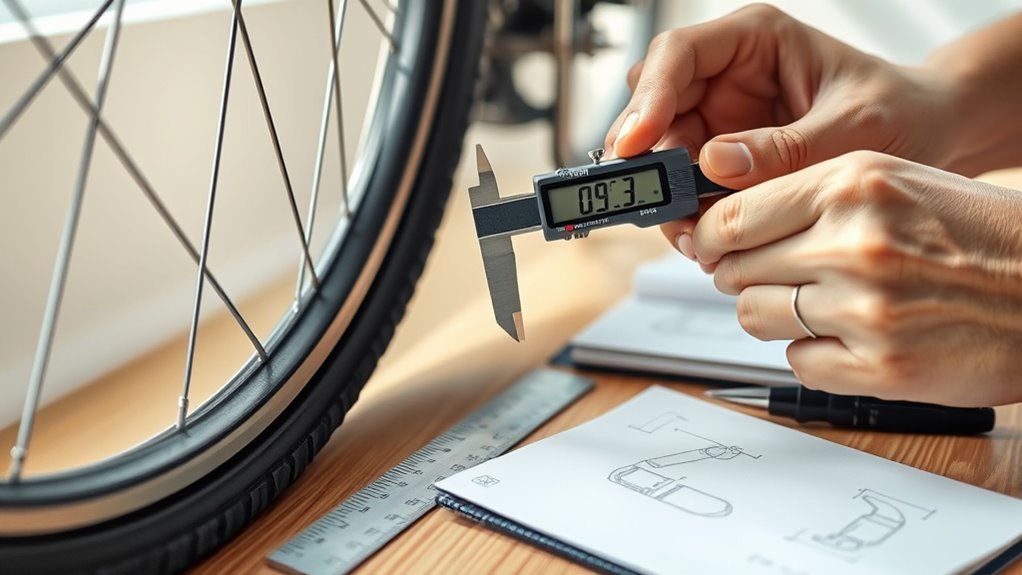
Measure the tire’s diameter by finding the distance across the tire through the center hub, then double it for the full size. It’s easier to do with a tape measure or a ruler.
Next, measure the width across the widest part of the tire without squishing it. This helps you understand how wide your tire really is when it’s in use.
Understand that sizes come in ISO (millimeters) and traditional (inches) formats. Knowing both can help you pick the right replacement tire.
Finally, check your numbers against standard size charts to guarantee a proper fit.
Following these steps will help you get precise measurements and choose the right tire. It’s a simple process that saves you time and hassle later on.
Prepare Your Bicycle for Accurate Measurement
Before you measure your bike tire, make sure your bicycle is stable by standing it upright with a kickstand or leaning it against a sturdy wall. This stability is vital for an accurate measurement.
Next, inflate the tire fully—an underinflated tire can give you a smaller measurement, while an overinflated one might stretch the rubber and skew results.
Check the tire for any debris or mud that could interfere with your measurement; cleaning it guarantees precision. Use a tape measure or ruler to take your measurements directly across the tire’s outer edges.
Measure the Tire Diameter Correctly
When you measure your bike tire diameter, keep the wheel steady by standing the bike upright or leaning it against a wall. Use a tape measure to find the distance from the wheel’s center hub to the outermost edge of the tire tread.
Record this measurement carefully. To get the full tire diameter, double the radius by measuring from one outer edge across the wheel to the opposite outer edge.
For ISO sizing, focus on the measurement from the wheel center to the inner edge of the tire bead and double it to find the total diameter in millimeters. This precise measurement helps confirm your tire diameter and ensures you select the right replacement or compatible tire size.
Measure the Tire Width Precisely
Now that you’ve measured the tire diameter, turn your attention to the tire width. Accurate tire width measurement requires the tire to be at full inflation and mounted on the rim.
Follow these steps to get a precise width:
- Place your tape measure across the widest part of the tire tread, perpendicular to the wheel’s centerline.
- Keep the tape snug without compressing the tire sidewalls to avoid skewing the measurement.
- Measure at several points around the tire’s circumference and record the largest sidewall-to-sidewall reading in millimeters or inches.
This method ensures you capture the true tire width. That way, you get the exact measurement needed for proper fit and performance.
Understand the ISO and Traditional Size Formats
Although tire measurements can seem confusing, understanding both the ISO and traditional size formats will help you choose the right bike tires with confidence.
ISO sizes use millimeters to specify tire width and bead seat diameter, displayed as width x diameter—for example, 25-622. This precise system guarantees a perfect fit, with 622 mm commonly matching the 700c wheel diameter.
Traditional sizes, on the other hand, list diameter first, then width in inches, like 26 x 2.1. While less exact, traditional sizes remain popular and widely recognized.
Knowing these differences in tire size formats lets you navigate various brands and bike types more easily. By learning to read both ISO sizes and traditional sizes, you’ll avoid mismatches and pick tires that truly fit your bike.
Verify Your Measurements Against Standard Tire Sizes
Since tire measurements can vary slightly, you should compare your diameter and width to standard size charts to find the best match. This guarantees you select the correct tire size and avoid issues with fit or performance.
Comparing your tire measurements to standard charts ensures the perfect fit and optimal performance.
Here’s how to verify your measurements:
- Check your measured ISO diameter against standard size charts to find the closest match, like 700 x 25mm or 26 x 2.1.
- Use the ISO system numbers (e.g., 25-622) to confirm compatibility with your rim.
- Cross-reference your measurements within a few millimeters against manufacturer specs or official charts for accuracy.
Conclusion
Now that you know how to measure your bike tire size accurately, isn’t it easier to find the perfect replacement or upgrade?
By preparing your bike and measuring both diameter and width carefully, you’ll avoid confusion and guarantee a great fit. Understanding size formats is key to making the right choice every time.
Don’t forget to double-check your numbers against standard sizes for the best results. This extra step ensures your new tires fit perfectly and perform well.
With these simple steps, you’re ready to keep your ride smooth and safe every time. Measuring bike tire size correctly helps you maintain optimal performance and comfort on every journey. So, take a few minutes to measure your bike tires properly—it’s worth it for a safer, smoother ride!