10 Facts About How Fast a Bike Can Go
Your bike’s speed depends on several key factors like motor wattage, total weight, terrain, and how much pedal assistance you use. These all play a big role in how fast you can go.
Lighter setups and an aerodynamic posture really help you accelerate and keep higher speeds for longer.
Hills and rough roads tend to slow you down, while smooth pavement and tailwinds give you a nice boost. Keep in mind that legal limits often cap assistance for safety reasons, but your own effort still matters beyond that.
Also, don’t forget to keep your tires properly inflated—it makes a noticeable difference. Choosing smart routes that avoid rough terrain can help too.
Keep exploring all these factors to unlock your bike’s full speed potential and enjoy the ride!
Key Takeaways
- Motor wattage directly affects acceleration and top speed, with legal limits typically capping assistance at 750 W or set speeds. This means the more powerful the motor (within legal limits), the quicker and faster you can go.
- Rider weight, bike weight, and aerodynamics significantly influence achievable speeds, especially on flat terrain. So, a lighter rider and bike with a sleek design usually means better speed.
- Terrain and environmental factors like hills, wind, and road surface impact how fast a bike can maintain speed. For example, going uphill or against strong wind will naturally slow you down.
- Pedal assistance and throttle control help reach and maintain legal speed limits efficiently, balancing power and rider effort. It’s all about finding the right mix so you don’t burn out your battery too quickly.
- Proper tire pressure, bike maintenance, and aerodynamic riding positions optimize speed and extend battery range. Keeping your bike in good shape and riding smart can make a noticeable difference.
How Motor Wattage Determines Your E-Bike Speed
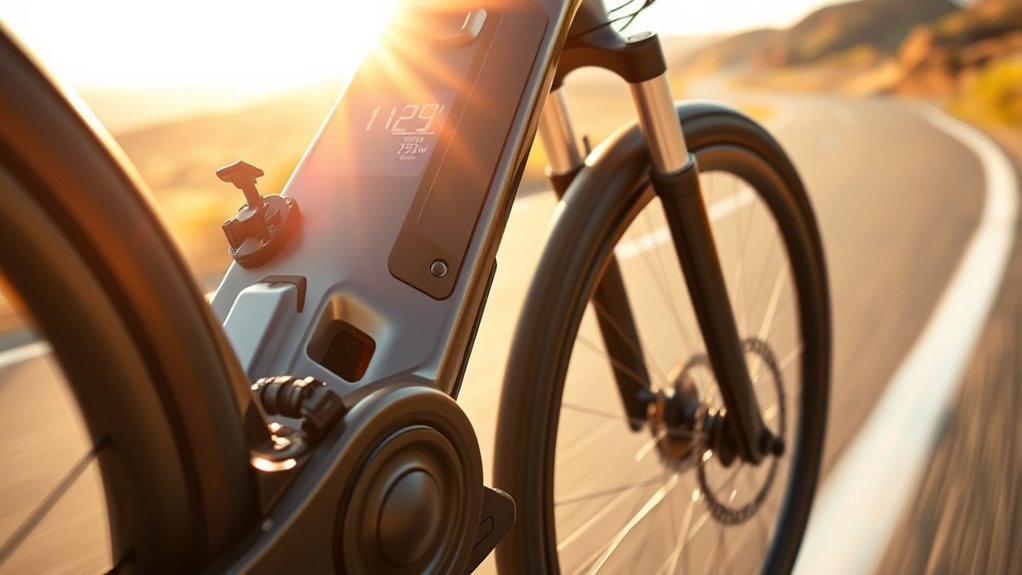
Although many factors affect an e-bike’s speed, motor wattage plays a crucial role in determining how fast you can go. The motor wattage directly impacts your e-bike’s ability to accelerate quickly and reach a higher top speed.
Motor wattage is key to how fast your e-bike can accelerate and reach higher speeds.
For instance, a 750 W motor delivers more power than a 250 W motor, letting you tackle inclines faster and carry heavier loads without slowing down. This extra power translates into quicker acceleration and a higher potential top speed, especially on flat terrain.
However, keep in mind that legal speed limits often restrict motor wattage, with many regions capping assistance at 750 W, which limits how fast you can legally ride. While a higher motor wattage supports faster speeds, your actual top speed still depends on factors like your effort, the terrain, and the bike’s design.
Understanding motor wattage helps you pick an e-bike that matches your speed and performance needs. So, knowing this can really make your choice easier and ensure you get the ride you want.
Why Total Weight Affects E-Bike Acceleration and Top Speed
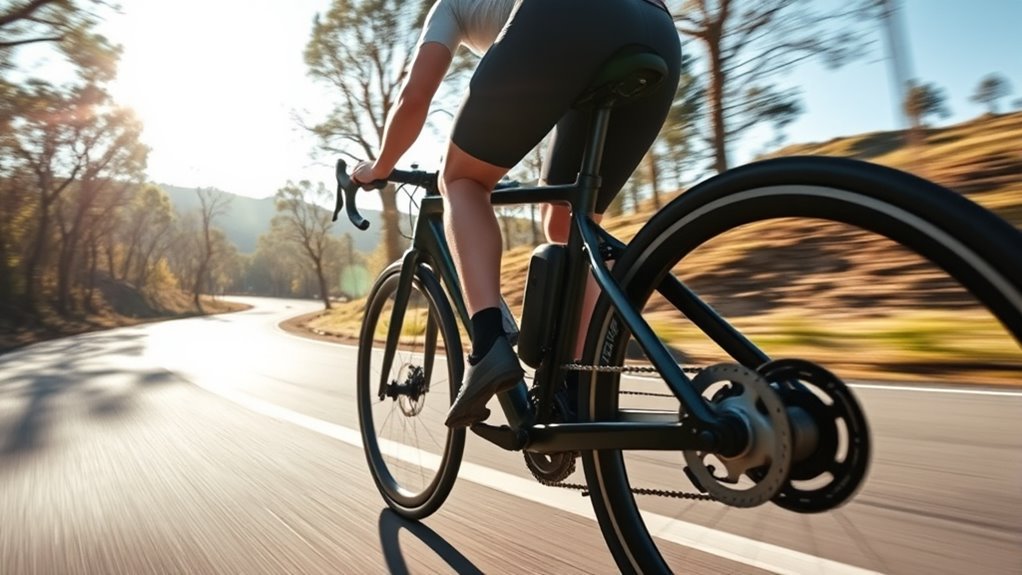
Motor wattage definitely influences your e-bike’s speed, but the total weight you’re carrying—both the bike and rider—also plays a big role in how quickly you accelerate and how fast you can maintain your pace.
When your total weight is lighter, your e-bike reaches higher speeds with less effort. Acceleration improves because the motor doesn’t have to work as hard to overcome inertia. Even shedding just 500 grams can slightly boost acceleration, although top speed on flat roads depends more on aerodynamics than weight.
On the other hand, heavier setups demand more power to accelerate and keep up high speeds. This impact is most noticeable during climbs or rough patches.
How Terrain and Hills Influence Your E-Bike’s Performance
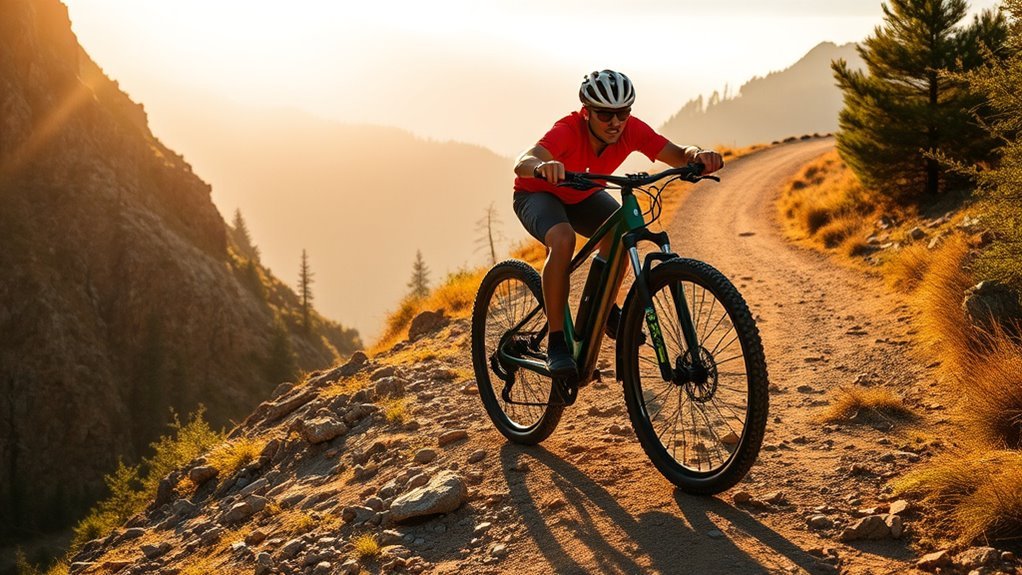
When you ride uphill, your e-bike slows down because the motor has to work harder against gravity.
On the other hand, going downhill lets you pick up speed easily, often surpassing your usual top speed.
The type of terrain you choose also affects how fast you can go, with smooth pavement offering the best conditions for speed.
Terrain Impact On Speed
Since terrain plays a major role in your e-bike’s speed, understanding how hills and surfaces affect performance is essential. Uphill terrain slows you down due to gravitational resistance, demanding more motor power.
Smooth downhill slopes boost speed dramatically. On the other hand, rough surfaces increase rolling resistance, which slows you down.
Wind conditions add another layer to consider. They often reduce speed or cause instability, making your ride a bit trickier.
| Terrain Type | Speed Impact |
|---|---|
| Uphill | Decreases speed |
| Downhill | Increases speed |
| Smooth pavement | Maximizes speed |
| Rough surfaces | Reduces speed |
| Wind conditions | Slows or destabilizes |
Uphill Versus Downhill
Although hills challenge your e-bike’s speed, understanding how uphill and downhill terrain affect performance helps you ride smarter. When you tackle uphill routes, gravity works against you, slowing your bike and forcing the motor to use more power to maintain speed.
Steeper and longer uphill climbs reduce your pace considerably. On the flip side, downhill slopes give you a boost, letting gravity push you faster—sometimes over 30 mph.
However, motors often reduce or cut out assistance when you descend quickly, so you rely more on gravity and your control. Remember, factors like wind and surface conditions also influence how uphill and downhill terrain impact your ride.
Knowing these effects helps you manage speed and effort efficiently on varied hills.
How Pedal Assistance and Throttle Affect E-Bike Speed
Understanding how pedal assistance and throttle influence your e-bike’s speed helps you make the most of its capabilities while staying within legal limits. Most e-bikes rely on pedal power, providing assistance up to set speeds—20 mph for Class 1 and 2, and 28 mph for Class 3.
Knowing how pedal assistance and throttle affect speed helps optimize your e-bike while adhering to legal limits.
Throttle systems, on the other hand, let you accelerate without pedaling but also obey speed caps based on local laws.
Here’s how these factors affect your ride:
- Pedal assistance boosts your speed smoothly until it hits the legal limit, making pedaling easier and quicker.
- Using the throttle lets you control speed instantly, but it won’t push beyond regulated maximums.
- Beyond assistance cutoffs, your own effort determines how fast you can go, so pedal power still matters.
Why Rider Fitness Is Key to Riding Faster
When you build stronger legs and improve your overall fitness, you’ll generate more power on the pedals. This directly boosts your cycling speed.
Rider fitness also helps you transfer power more efficiently. That means you can keep up higher speeds longer without getting tired so fast.
Beginners might manage 100–150 watts, while trained cyclists can exceed 250 watts. This clearly shows how fitness affects power output and speed.
Regular training improves muscle efficiency, making every pedal stroke count more.
Here’s a quick comparison:
| Fitness Level | Average Power Output (watts) |
|---|---|
| Beginner | 100–150 |
| Intermediate | 150–200 |
| Advanced | 200–250 |
| Elite | 250+ |
How Aerodynamics and Riding Position Boost Your Speed
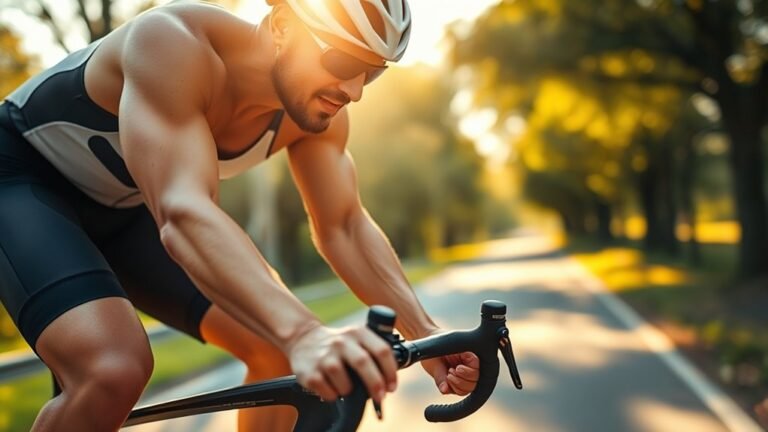
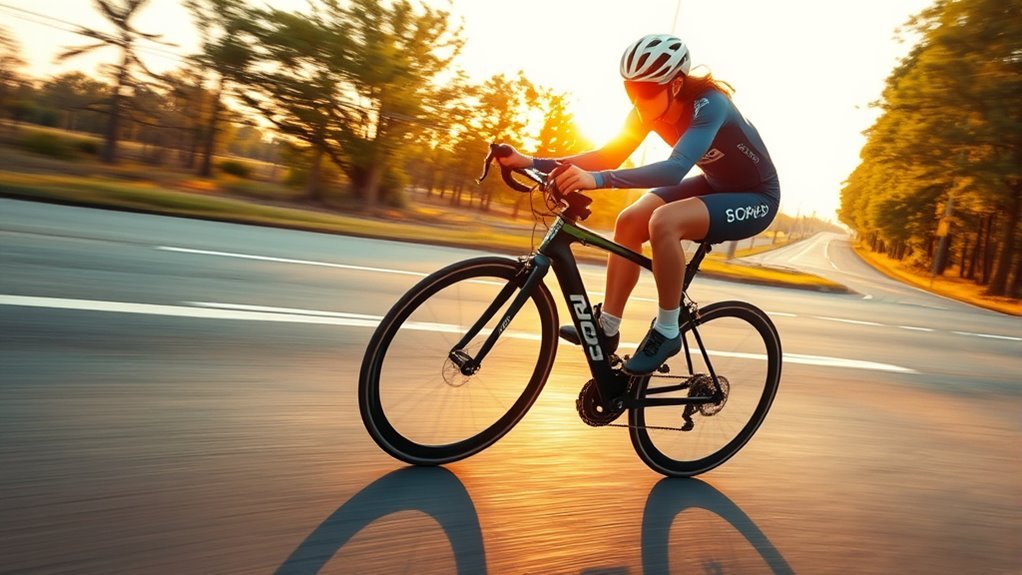
You can boost your speed by adjusting your riding posture to reduce air resistance, like lowering your torso and bending your elbows. Wearing aerodynamic gear, such as streamlined helmets and tight-fitting apparel, also helps cut drag.
Together, these changes let you maintain higher speeds with less effort. It’s pretty simple but makes a big difference when you’re out on the road.
Riding Posture Effects
Although increasing your power output can help, adopting a more aerodynamic riding posture makes a bigger difference in cutting air resistance and boosting your speed.
By adjusting your body position, you can markedly reduce drag and ride faster with less effort. Focus on these key posture tweaks:
- Lower your torso and bend your elbows to reduce frontal area, cutting air resistance by up to 30%.
- Keep your head tilted down and elbows tucked close to your body to streamline airflow.
- Wear fitted clothing that complements your riding posture to maximize aerodynamics.
These small changes in riding posture have a profound impact on speed, especially at higher velocities.
You’ll find that optimizing aerodynamics through posture often outperforms simply pedaling harder.
Aerodynamic Gear Benefits
Mastering your riding posture sets the stage, but pairing it with aerodynamic gear amplifies the speed gains even more. When you combine a lower, forward position with aerodynamic bike frames and components, you cut air resistance markedly, boosting your top speed by up to 10-20%.
Wearing fitted, aerodynamic clothing and helmets further slashes drag, saving energy and letting you ride faster with less effort. Aerodynamic handlebars and aero tubes also reduce wind resistance, especially once you hit speeds above 20 km/h.
Why Tire Choice and Road Conditions Matter for Speed
Because the contact between your bike’s tires and the road directly affects rolling resistance, choosing the right tires and maintaining proper inflation are essential for speed. Tire pressure plays a vital role—underinflated tires increase resistance, making it harder to keep your pace, especially on long rides.
Riding conditions also influence how efficiently you can pedal; smooth, well-maintained roads let you conserve energy and go faster.
Here’s why this matters to you:
- Proper tire pressure minimizes rolling resistance, helping you maintain higher speeds effortlessly.
- Selecting the right tire width balances speed and control, adapting to your typical riding conditions.
- Smooth road surfaces reduce energy loss, letting you ride faster with less fatigue.
How Environmental Factors Like Wind Impact Your Ride
When you face strong winds during your ride, your speed and control can take a hit. Headwinds slow you down by several kilometers per hour, forcing you to pedal harder to maintain momentum.
Crosswinds challenge your stability, especially at higher speeds, so you need to adjust your grip and balance carefully. Calm weather and smooth pavement let you maximize your speed with less resistance.
On the other hand, rough terrain increases rolling resistance and saps your energy. Understanding how wind affects your ride helps you anticipate changes and adapt your technique.
| Wind Direction | Impact on Speed |
|---|---|
| Headwind | Decreases speed |
| Tailwind | Increases speed |
| Crosswind | Affects stability |
| Calm | Optimizes speed |
| Gusty | Requires control |
How Legal Speed Limits Restrict Your E-Bike Speed
Although e-bikes can reach impressive speeds, legal limits keep their motor assistance within safe boundaries. These speed limits and e-bike regulations guarantee your safety and respect traffic laws, preventing you from relying on motor power beyond set speeds.
Here’s how these restrictions affect you:
- In the US, Class 1 and 2 e-bikes cap motor assistance at 20 mph, so you’ll feel the boost cut off once you hit that speed.
- UK e-bikes stop assisting at 15.5 mph, regardless of motor strength, meaning you must pedal harder to go faster.
- Class 3 e-bikes in the US can assist up to 28 mph but may face local speed limits that reduce this, depending on where you ride.
These legal speed limits might feel limiting but are designed to keep you safe. They make sure your e-bike experience stays within controlled, manageable speeds.
Tips to Safely Maximize Your E-Bike Speed and Range
To safely boost your e-bike’s speed and extend its range, focus on smart speed control and efficient riding habits. Keep your tire pressure ideal, choose the right assistance level, and maintain your battery regularly.
These simple strategies help you get the most out of every ride without compromising safety. Just a few easy steps can make a big difference. Give them a try!
Speed Control Tips
If you want to get the most out of your e-bike’s speed and range, you’ll need to focus on smart speed control strategies. Mastering effective riding techniques and maintaining your bike can dramatically improve your ride.
Here are three essential tips to keep you safe while maximizing speed control:
- Keep your tires properly inflated and reduce extra weight. This lowers rolling resistance and helps your e-bike glide faster without overworking the battery.
- Use higher assistance levels thoughtfully and pedal efficiently to boost speed without draining power too quickly.
- Adopt an aerodynamic riding position and avoid rough terrain or steep hills to maintain consistent speed and conserve energy.
With these speed control tips, you’ll enjoy a smoother, faster ride while protecting your battery’s longevity. Give them a try and see the difference for yourself!
Range Optimization Strategies
While maximizing your e-bike’s speed is exciting, optimizing its range guarantees you can enjoy longer rides without running out of power. To achieve speed with less effort, maintain proper tire inflation between 80-100 PSI to reduce rolling resistance.
Use the highest efficient assistance level wisely to balance speed and battery life. Choose smooth, paved surfaces for riding, as they minimize surface resistance and help maintain safer speeds.
Lighten your load by reducing rider weight and removing unnecessary accessories, which improves acceleration and extends your battery’s reach. Plan routes with gentle inclines, avoiding steep hills to conserve battery power.
These range optimization strategies ensure you get the most from your e-bike, combining speed with less energy use for longer, more enjoyable rides.
Frequently Asked Questions
Can You Go 300 Mph on a Bike?
You can’t go 300 mph on a bike right now. The technology and human power needed just aren’t there yet.
Even the fastest bikes fall far short of that speed, so it’s not possible for you. Sorry to break it to you, but we’re just not at that level yet!
Can a Bicycle Go 200 Mph?
You can’t reach 200 mph on a bicycle using just your pedaling power. Even the fastest human-powered bikes don’t come close.
To hit that speed, you’d need a motor or some other external propulsion. It’s just not possible to do it by pedaling alone.
How Fast Can a Bike Go?
You can reach speeds up to around 90 mph on a specially designed bike, but typically, you’ll cruise between 8-31 mph depending on your effort, bike type, and terrain.
Electric bikes top out near 28 mph. So, it really depends on what kind of bike you’re riding and where you’re riding it!
Can a Bicycle Go 60 Mph?
You can ride a bicycle at 60 mph, but it’s like chasing lightning—possible only with perfect conditions, a sleek aerodynamic design, and a downhill rush.
Otherwise, your bike’s wings won’t quite catch that speed.
Conclusion
You’ve learned how motor wattage, weight, terrain, and even tire choice influence your e-bike’s speed. Remember, just like a knight relying on his trusty steed, your rider fitness and pedal power play a huge role too.
While legal limits keep you safe, you can still maximize speed with smart tips. So gear up, stay aware, and enjoy the ride—your e-bike adventure is ready to blast off, faster than a horse and carriage ever could!
When it comes to boosting how fast a bike can go, every detail counts. From choosing the right tires to understanding the impact of terrain and rider strength, you have the power to enhance your e-bike’s performance. Stay safe, ride smart, and feel the thrill of speed with your electric bike!